
Part of the Hiring Your First Employee hub.
You’re probably not thinking about hiring because everything feels calm and beautifully organised.
You’re probably thinking about hiring because your inbox is full, clients are waiting, your brain is tired, and you have started saying, “I just need someone to help me.”
And maybe you do.
But needing help and being ready to hire someone are not the same thing.
You might be at the point where every extra enquiry feels like both a win and a problem. The business is growing, but so is the pressure. And when you are tired, it is very easy to confuse “I need relief” with “I need an employee.”
That distinction matters because the wrong hire, made at the wrong time, does not just cost money. It creates more decisions, more responsibility, and sometimes more pressure than you had before.
Wanting more help is normal, but it doesn’t always mean it is time to hire. Hiring without proper preparation often leads to cash flow pressure, unclear roles, and a team member who cannot succeed in the business you have right now. Sometimes the problem is workload, but sometimes it is a lack of clarity, messy processes, inconsistent income or avoidance of decisions. Your business might not be stable enough for new staff.
This article talks about when you should slow down. Taking time to fix your business first is smart. It keeps your company stable and profitable when things change.
Being “not ready to hire yet” does not mean your business is failing. It often means your business is giving you useful information. In HR, one of the biggest mistakes I see small business owners make is treating hiring as the solution before they have diagnosed the actual problem. Something likely needs to be tightened, clarified, documented, priced, automated, or stabilised before you add another person into the mix.
Key Takeaways
- Before hiring, check your cash flow, processes, leadership capacity and employer responsibilities.
- Feeling overwhelmed does not automatically mean you are ready to hire.
- A first employee needs a clear role, not a vague pile of tasks.
- If too much of the business still lives in your head, your first step may be to document rather than recruit.
- Being “not ready yet” is not failure. It is a useful warning sign that something needs strengthening first.
Sign 1: Financial Stability – You Cannot Clearly Afford the Hire Yet
What this looks like in real life:
You have had a couple of strong months, and it finally feels like things are working. You start thinking, “I can afford help now,” but if you look honestly, income still fluctuates, and there is no consistent baseline yet.
Or you have worked out the salary, but not the full cost of employing someone, the pension, National Insurance, software, equipment, and the time it will take you to manage them.
It feels like a growth decision, but there is still some guesswork about the finances.
Being financially healthy is key to any small business’s growth. This is where many small business owners get caught. They look at the salary and think, “I can just about make that work.” But employment is not just a salary. It is a monthly commitment, employer costs, management time, tools, payroll, pension responsibilities, and the emotional weight of knowing someone else is relying on the business, too.
Before you hire, check if your company can afford to grow. It’s important to have enough money for long-term success.

Analysing Your Monthly Cash Flow Consistency
Don’t confuse one good month with a trend. Look at your income over the last year. This helps you see if you can afford to hire.
Make sure your income is steady. It should cover your current costs and the new salary. Consistency is more important than a one-time increase in sales. If your money flow is unpredictable, save more before hiring. Unfortunately, hoping future sales will cover the salary is not quite enough.
The Hidden Costs of Employment Beyond Salary
Don’t just look at the salary when hiring. There are hidden expenses that can surprise you. As a rough planning exercise, do not budget only for salary. Build in a buffer for employer costs, tools, training, and management time. These can add 20% to 30% to the salary, depending on your location.
From an HR perspective, one of the warning signs is not simply “I cannot afford this person.” It is “I can only afford them if everything goes perfectly.” That is not a stable hiring plan. That is a hope-based hiring plan.
Here’s a list of typical costs when hiring someone in the UK:
| Expense Category | Description | Estimated Impact |
|---|---|---|
| Employer Costs | National Insurance contributions | High |
| Equipment | Laptop, software, desk, payroll software, and accounting fees | Medium |
| Benefits | Pension and health insurance | High |
| Training | Onboarding and development training time |
Low |
Evaluating Your Runway for Long-Term Commitments
Hiring creates a monthly commitment, a legal responsibility, and a management relationship. It is not the same as buying a tool you can cancel next month. You need to know how long your business can last if sales drop. A good runway means you can handle market changes without worry.
If you’re ready to hire, you have enough money to cover at least 6 months of the new employee’s costs. This safety net helps your small business during tough times. Always choose stability over fast growth.
Ask yourself: If my income dropped over the next 2–3 months, could I still pay this person consistently without stress or second-guessing?
Sign 2: You Are Hiring Because You Feel Overwhelmed, Not Because The Role Is Clear
What this looks like in real life:
You are overwhelmed, your to-do list is never-ending, and your brain keeps saying, “I just need someone.”
But when you try to explain what that person would actually do, it becomes vague. A bit of admin, a bit of client work, a bit of everything.
A role built around your stress will usually become messy very quickly. The person starts with admin, then gets pulled into client work, then gets asked to fix marketing, chase invoices, organise files, reply to emails, and somehow “take initiative” in a business they do not yet understand.
The pressure you feel is real, but the role itself is not yet fully formed.
Overwhelm is a real problem, but it is not a job description.
You must make sure your small business can handle the job. Becoming an employer means handling payroll, contracts, pensions, compliance, and the day-to-day responsibility of supporting someone to do their job well.

Distinguishing Between Temporary Workload Spikes and Sustainable Growth
Many entrepreneurs think a busy season means they need more staff. You may find some weeks are overwhelming, while others are quiet; the pressure can feel urgent but temporary, and the revenue can come in waves. Founders are trying to hire in those moments because they react to short-term needs.
Before hiring, check whether your demand is seasonal or growing. This keeps costs down while you check if your growth is real. You may also find that your business needs better planning, simpler offers, clearer systems or if it’s just for a few weeks, think about freelancers.
Being ready to hire means you have enough work for a part-time or full-time salary for a long time.
Identifying the Specific Gaps in Your Current Operations
A good hiring process starts with knowing your weak spots. Map out your tasks to see where you’re losing time. If you’re stuck on admin, you might need someone to help.
Ask yourself: Am I hiring because I have a clearly defined role to fill, or because I feel overwhelmed and need relief?
The Risks of Hiring Out of Desperation
Hiring when stressed is risky. Rushing the hiring process can lead to overlooking problems. This can cause high turnover, which is costly.
Take time to think about your needs before hiring. A calm, careful approach ensures you hire for the right reasons.
Sign 3: Too Much Of The Business Still Lives In Your Head
What this looks like in real life:
Someone asks you how to do a task, and your answer is, “It depends,” followed by you talking it through step by step.
You are making decisions in the moment, based on experience, instinct, or memory, but none of it is written down.
It works because it is you. It becomes a problem the moment someone else needs to repeat it without you sitting next to them.
Many business owners forget about their internal processes until a new hire asks, “How do I do this?” If you are hiring now, the state of your documentation will affect how quickly your new hire becomes productive. A messy environment can frustrate both the manager and the new employee. In short, if you have no documented workflows, no checklists or templates, each task is done differently every time, or only you know how things work, you are not setting them up for success.
Why Standard Operating Procedures Are Essential for New Starters
Standard Operating Procedures (SOPs) are like a blueprint for your business. Clear written instructions remove the guesswork from daily tasks. This lets your new team member start without constant watching.
A detailed onboarding process means every new starter gets the same training. A reliable guide lets staff solve problems on their own. This saves time and reduces mistakes in the future.
The Danger of Being the Only Person Who Knows How Things Work
Legacy knowledge is information in your head or a small group. Relying on it is dangerous when hiring. If a key process isn’t written down, it’s lost for new employees.
This could be how you onboard a client, how you answer enquiries, how you price a project, how you decide what gets urgent attention, or how you know when a piece of work is “good enough.” None of it feels like a system because you have been doing it for so long.
Keeping important workflows in your mind slows business growth. You risk losing key knowledge if a team member leaves. Documenting your expertise protects your company’s growth and ensures it keeps going. Every piece of undocumented knowledge has to be learned again from scratch.
Preparing Your Workflow for Seamless Onboarding
To get ready for a new hire, audit your workflows for gaps. Map out the tasks your new employee will do. If a process is missing a step or relies on verbal instructions, write it down before hiring.
Make a digital place for all your guides and templates. This centralised hub helps new starters find what they need without interrupting you. Organising your systems now supports long-term success.
Ask yourself: Could someone complete this work to a good standard without asking me constant questions, or does too much of it still live in my head?
Sign 4: You Do Not Have Time To Support The Person You Want To Hire
What this looks like in real life:
You are already stretched. Your days are full, your energy is limited, and you hope that hiring someone will take the pressure off immediately.
But in reality, bringing someone in means answering questions, reviewing work, giving feedback, and being available when they get stuck.
Instead of creating space, it initially adds another layer of responsibility, one you may not currently have the capacity for.
If you’re thinking about hiring now, look at your management style first. Many think adding staff solves productivity issues. But hiring someone new takes a lot of your time and emotional energy.
Assessing Your Available Time for Training and Support
You can teach technical skills, but attitude is harder to train. You’ll need to spend hours mentoring your new hire. If your schedule is full, you might not have time to guide them well. Your new hire may not save you time immediately.
Effective mentorship is ongoing, not a one-time thing. You must be ready for questions, feedback, and regular meetings. Without this, even the best new hire will feel lost and won’t do well. So you will need time and headspace to onboard and mentor someone.
The Shift from Individual Contributor to Team Leader
Going from doing the work yourself to leading a team is the next step in your business’s growth. You’ll move from doing the work to getting results through others. This means letting go of control and trusting your team.
This is the part many first-time employers underestimate. A new person does not simply arrive and remove work from your plate. At first, they need context, decisions, examples, reassurance, corrections, feedback and time with you.
That does not mean hiring is a bad idea. It means you need enough space to lead the person, not just enough money to pay them.
When you’re hiring, you must learn to delegate. This change might feel hard at first, but it’s key to growing your business. You need to focus more on your team’s success than on your own work.
Recognising When You Lack the Skills to Manage Others
It’s okay if you realise you can’t manage a team yet. Being great at your job doesn’t mean you will be a good manager. You might need to get leadership training or hire someone more experienced than you.
The table below shows the main differences between being an individual contributor and a leader:
| Focus Area | Individual Contributor | Team Leader |
|---|---|---|
| Primary Goal | Personal Output | Team Performance |
| Time Allocation | Task Execution | Mentorship & Strategy |
| Success Metric | Completed Projects | Team Growth & Retention |
Knowing your limits is a sign of strong leadership. If you can’t mentor, it’s better to wait than to hire someone you can’t support. Your ability to lead will decide your new team member’s success.
Ask yourself: Do I have the time and energy to properly train, support, and review someone, or am I hoping they will take work off me immediately? Look at your diary and ask: where will the weekly check-in go? Where will training happen? When will I review their work? When will I answer questions without becoming resentful?
Sign 5: You Have Not Prepared For The Responsibilities Of Becoming An Employer
What this looks like in real life:
You know there are “things you need to set up,” but you are not entirely sure what they all are or when they need to be done.
You might be thinking about contracts, but not yet about payroll, pensions, insurance, or ongoing obligations as an employer.
It feels like something you will figure out once the person is in place, rather than something to prepare properly in advance.
Hiring your first employee is exciting, but it comes with new legal responsibilities. Before starting your recruitment, you must be aware of the laws within your locale. Not being ready can cause stress and cost you money.
Navigating Employment Law and Contractual Obligations
Every worker in the UK gets certain rights from day one. You must provide a written statement detailing the work. This includes pay, hours, and holiday time. In the UK, becoming an employer is not just a mindset shift. It brings practical responsibilities, including checking someone’s right to work, setting up payroll and PAYE, understanding pension duties, issuing the correct employment documents, managing holiday and pay correctly, and ensuring you have the right insurance in place.
Keeping up with your local laws is key. Your contracts must match the latest rules to protect your business and staff. Clear documents are the basis of a good work relationship.
The Administrative Burden of Payroll and Pension Auto-Enrolment
Handling payroll can be challenging; in the UK, you need to register with HMRC and use PAYE for taxes and National Insurance. This means checking everything every month.
You also must offer a workplace pension. With pension auto-enrolment, you must help eligible staff save for retirement. Getting these deductions right is crucial for any UK business owner.
Why Ignoring Compliance Can Jeopardise Your Business
Ignoring laws can harm your business and cause legal problems. Fines from regulators can hurt a small company’s finances. Protecting your reputation is as important as avoiding fines.
When you focus on employment rules, you respect your team and help create a good place to work. Getting these tasks right early lets you grow your business with confidence. Always ask for help if these rules seem too hard.
You do not need to become an employment law expert overnight. But you do need to know what cannot be guessed, delayed, or copied from a random template online.
Ask yourself: Do I understand what I need to set up and manage as an employer, or am I planning to figure it out after hiring?
Sign 6: You Know You Need Help, But Not What Success Should Look Like
What this looks like in real life:
If someone asked you, “What would success in this role look like after 3 months?” you would struggle to give a clear answer.
You know you need help, but the role’s boundaries keep shifting depending on what feels urgent that day.
Without clear expectations, you risk hiring someone busy but not actually moving the business forward in the way you need.
Before you post any job opportunities, you must clearly define what success looks like for the position. Many business owners rush into the recruitment process without a concrete plan. This leads to mismatched expectations and wasted resources.
Taking the time to map out the specific impact you need a candidate to make is the most effective way to ensure long-term success.
A vague role usually creates a vague hire. And a vague hire creates vague disappointment. You feel frustrated because your new hire is not taking enough off your plate. They feel confused because the target keeps moving.
The Importance of a Clear Job Description
A well-crafted job description serves as your primary filter for talent. It should go beyond a list of tasks and focus on the outcomes you expect the person to achieve. When you explain the role clearly, the right person can understand what they are walking into and whether they are genuinely suited to it.
“Hire for character, train for skill. Strong credentials do not equal strong character, and a resume is only a snapshot of the past, not a guarantee of future performance.”
Setting Realistic Performance Metrics for New Hires
Once you have identified the right person, you need to establish clear performance metrics. These benchmarks help your new hire understand exactly what is expected of them from day one. By setting measurable goals, you remove ambiguity and provide a roadmap for their professional development within your company.
Consider using the following table to differentiate between the needs of your business when evaluating potential candidates:
| Focus Area | Specialist Approach | Generalist Approach |
|---|---|---|
| Primary Goal | Deep technical expertise | Broad operational support |
| Best Use Case | Complex, niche projects | Early-stage startup growth |
| Risk Factor | Limited flexibility | Lack of depth in tasks |
Avoiding the Trap of Hiring a Generalist for a Specialist Role
A common mistake is hiring a generalist when your business actually requires a specialist. While generalists are excellent for small teams that need “all-hands-on-deck” support, they may struggle with highly technical or complex requirements. Always assess whether your current requirements demand a deep dive into a specific field or a wide range of administrative skills.
Remember that strong credentials are not a substitute for the right personality or cultural fit. Focus on finding someone whose values align with your vision. This will ultimately lead to better results for both you and your future employee. By being precise about your needs, you build a stronger, more resilient team.
Ask yourself: Could I clearly explain what success in this role looks like in 30, 60, and 90 days? For example, within 30 days, they might understand your systems and complete simple tasks with support. In 60 days, they might own a repeatable process. Within 90 days, they might reduce your involvement in a specific area of the business.
What to Do Instead If You Are Not Ready to Hire Yet
What this looks like in real life:
You assume your only two options are “keep doing everything yourself” or “hire someone.”
But often, the pressure comes from a mix of repetitive tasks, unclear processes, or work that does not actually need to be part of your business in the long term.
Hiring feels like the solution, when in reality, a lighter, more flexible step could solve the immediate problem without adding long-term pressure.
Scaling your business doesn’t mean you must hire more people right now. If your workload is just temporary or you’re not ready for the commitment, you have other options. These choices let you keep working well without spending too much.
If you are not ready to employ someone yet, the next step is not to keep drowning. The next step is to choose the lightest form of support that solves the real problem.
- Automate if the task is repetitive.
- Document the task if it lives in your head.
- Outsource if the task is specialist but not core.
- Use a freelancer if the need is project-based or occasional.
- Hire when the work is ongoing, affordable, defined and strategically important.
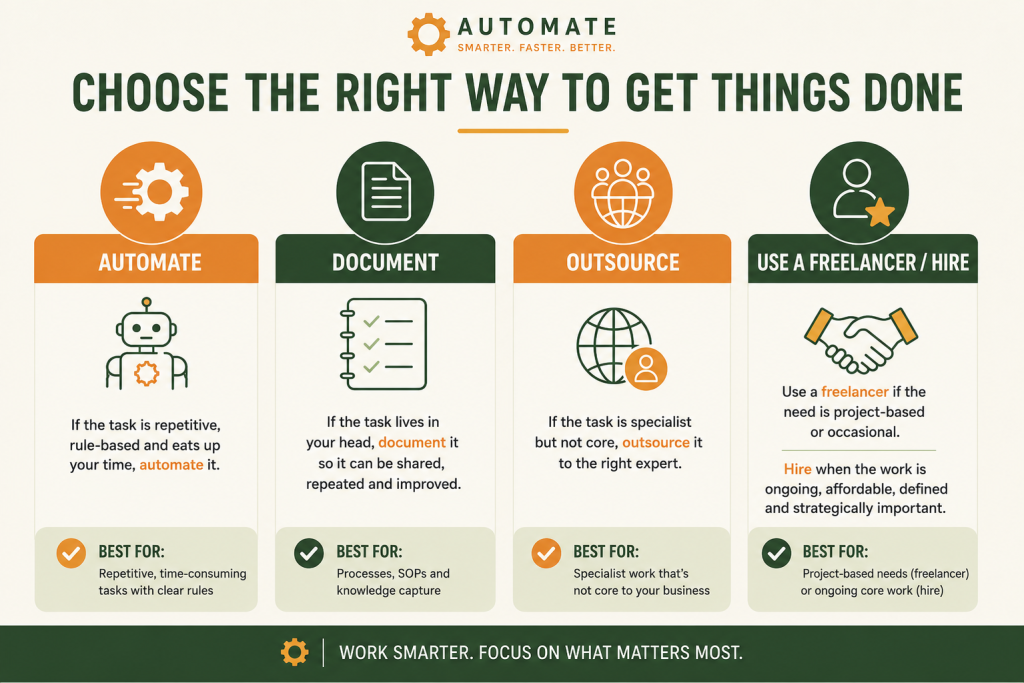
Automating Tasks to Delay the Need for New Staff
Automation is useful when the task is repeatable and predictable. It is not a magic fix for a messy business. Before you automate, ask: Do I actually understand the process, or am I just trying to make the chaos move faster?
Using smart software, you can do more with less. This means you can delay hiring and save money for other important things.
Leveraging Freelancers and Contractors for Project-Based Work
Freelancers are great for specific tasks without the hassle of employment. You can get experts for short tasks like web design or technical help.
This way, you get top talent when you need it. When the task is done, you stop paying, keeping you flexible.
Outsourcing Non-Core Business Functions
Many owners spend too much time on admin tasks. Outsourcing tasks like payroll or customer support can save a lot of time.
By handing over these tasks, you can focus on growing your business. It’s often cheaper than hiring someone to do these jobs.
Ask yourself: Is hiring the only solution here, or could I reduce the pressure by simplifying, automating, or outsourcing first?
The Ready Test
Before you hire, check whether the role is:
- R – Recurring
- Is the work ongoing, or are you reacting to a temporary spike?
- E – Essential
- Does this work genuinely support growth, delivery, client experience or operations?
- A – Affordable
- Can you pay for the role consistently, including employer costs, tools, training and quieter months?
- D – Documented
- Could someone do the work without needing constant access to your brain?
- Y – Yours to lead
- Do you have the time, energy and willingness to manage this person properly?
If you cannot answer yes to most of these, the answer may not be “never hire.” It may simply be “not yet.”
Final Thoughts
I always encourage business owners to separate the feeling of being overloaded from the practical question of whether there is a stable, defined, affordable role here. Scaling your business is a big deal. It needs careful planning and a clear goal.
Before you hire someone new, check how your business is doing, and make sure your base is strong before adding new talent. This way, you keep your money safe and your work running smoothly.
Think about your long-term goals, not just today’s needs. When you hire people who share your values, they’ll want to stay and grow. This careful planning helps you avoid common mistakes.
The goal is not to delay hiring forever. The goal is to ensure your first hire steps into a business that is ready for them.
When your finances are stable, your role is clear, your processes are documented, and you have the capacity to lead, hiring becomes less of a panic move and more of a growth decision.
Not being ready to hire yet does not mean you are behind. It means your business is showing you where the foundations need attention before you add another person into the mix.
Maybe you need clearer finances. Maybe you need better systems. Maybe you need to define the role properly. Maybe you need to practise leading before someone is relying on you every day.
That pause is not wasted time. It is what turns hiring from a rescue mission into a responsible growth decision.
That is when you stop looking for someone to rescue the business and start building a team that can genuinely help it grow.
FAQ
How do I know if I am ready to hire my first employee?
Hiring your first employee is about much more than feeling busy. The right time to hire is when you have consistent work, a reliable income, and a clearly defined role that will continue beyond a temporary period of high activity.
You should also have enough time to train and support a new employee, as well as documented processes that explain how important tasks are completed. If your business still depends entirely on you remembering everything or making every decision, it may be worth improving your systems before bringing someone into the business.
A simple way to assess your readiness is to ask whether the role is Recurring, Essential, Affordable, Documented and Yours to lead—the READY test explained in this article.
Remember, delaying a hire until your business is properly prepared is often a sign of good leadership rather than hesitation. A well-prepared first hire is far more likely to become a long-term asset than someone brought in simply because you’re overwhelmed.
What are the signs I should not hire yet?
Several warning signs suggest your business may not be ready to hire just yet.
Common signs include:
- You cannot comfortably afford the salary and associated employer costs.
- You want “someone to help with everything” rather than having a clearly defined role.
- Important knowledge only exists in your head.
- You don’t have time to train or manage another person.
- Your workload has increased temporarily rather than consistently.
- You haven’t prepared for your legal responsibilities as an employer.
Many business owners mistake stress for readiness. Feeling overwhelmed is a genuine problem, but hiring isn’t always the best solution. Sometimes, documenting your processes, improving systems, outsourcing specialised work, or automating repetitive tasks can relieve immediate pressure without committing to permanent employment.
Taking time to strengthen your business first often makes your eventual first hire much more successful.
Should I hire an employee or use a freelancer first?
It depends on the type of work you need help with.
If the work is ongoing, forms a core part of your business and needs someone who will become part of your team, an employee may be the right choice.
However, if the work is specialist, occasional, or project-based, hiring a freelancer or contractor is often a lower-risk option. You gain access to expertise without committing to an ongoing salary or the responsibilities that come with employing someone.
For many small businesses, outsourcing is a valuable stepping stone between working completely alone and becoming an employer. It allows you to increase capacity while continuing to build your systems and cash flow.
Ask yourself whether you need someone permanently inside your business or simply to help complete specific tasks. The answer will often point you towards the right option.
How much money should I have before hiring someone?
There isn’t a single figure that applies to every business, but you should be able to comfortably afford much more than the employee’s salary.
You’ll also need to budget for employer National Insurance contributions, pension contributions where applicable, payroll, software, equipment, training, insurance, annual leave, and the time you’ll spend onboarding and managing the new employee.
A good question to ask yourself is:
“Could I still comfortably employ this person if business became quieter for the next three to six months?”
If the answer is no, you may be hiring too early.
A first employee should help your business grow, not create financial pressure that keeps you awake at night. Making sure you have healthy cash flow before recruiting gives both you and your employee the best chance of long-term success.
What should I prepare before hiring my first employee in the UK?
Before employing someone in the UK, make sure you’ve prepared both your business and your legal responsibilities.
This includes:
- Defining the role and writing a clear job description.
- Registering as an employer with HMRC.
- Setting up PAYE payroll.
- Understanding workplace pension responsibilities.
- Arranging Employers’ Liability Insurance.
- Preparing an employment contract and a written statement of employment particulars.
- Completing Right to Work checks.
- Creating an onboarding plan.
- Documenting your key business processes.
Just as importantly, make sure you’re personally ready to become a manager. Your role will begin to shift from doing all the work yourself to supporting someone else to do it well.
Preparing properly before recruitment reduces mistakes, helps new employees settle in more quickly and creates a much better experience for everyone involved.
What if I need help but cannot yet afford an employee?
If you’re not in a position to hire, don’t assume your only option is to keep struggling alone.
Start by looking at where your time is going. You can automate repetitive admin, outsource specialist work such as bookkeeping or marketing, use freelancers for project-based work, or simplify processes that have become unnecessarily complicated.
Many founders also discover that they are spending time on tasks that don’t genuinely contribute to growing the business. Removing or simplifying these activities can free up significant capacity.
The goal isn’t necessarily to hire as quickly as possible. It’s to build a business that is financially and operationally ready for employment when the time comes.
Sometimes the best investment isn’t another person, it’s creating better systems first.
What should my first hire actually do?
Your first hire should take ownership of work that is important, repeatable and clearly defined.
Rather than trying to find someone who can “help with everything”, focus on identifying the tasks that consistently take up your time but don’t necessarily require you personally to complete them.
For many small businesses, this might include customer enquiries, administration, scheduling, finance support, order processing or other operational tasks that keep the business running.
The best first role creates space for you to spend more time on activities that only you can do, such as winning new business, developing strategy, building client relationships or creating new products and services.
If you’re struggling to describe exactly what your first employee would be responsible for after three months, it may be a sign that the role needs more clarity before you begin recruiting. That extra planning now can make the difference between a successful first hire and an expensive mistake.